
Orthopedic Surgery Recovery Intensity Calculator
Select Your Procedure
Spinal Fusion
Vertebral joint fusionRevision Joint
Secondary replacementKnee Replacement
Total knee arthroplastyHip Replacement
Total hip arthroplastyShoulder Replacement
Upper body restorationYour Health Profile
Imagine waking up from surgery with a steel rod fused into your spine or a new titanium hip. You feel hopeful, but then reality hits: you can’t walk without help, bathing is a nightmare, and the pain feels like it’s never going to stop. If you are facing major orthopedic surgery, you likely have one burning question: how bad will the recovery be?
Patient forums are filled with stories of people who underestimated the grind of rehabilitation. While every body heals differently, some procedures are objectively harder than others due to the complexity of the anatomy involved, the extent of tissue damage, and the rigorous physical therapy required. Understanding which surgeries carry the heaviest recovery load helps you prepare mentally and physically before you even step into the operating room.
Quick Summary: The Toughest Recoveries
- Spinal Fusion: Often considered the hardest due to long-term restrictions on bending, lifting, and twisting (BLT).
- Total Hip Replacement: Requires strict adherence to movement precautions to prevent dislocation during the critical first three months.
- Complex Joint Revisions: Longer surgeries mean more tissue trauma, leading to extended swelling and slower mobility gains.
- Patellofemoral Arthroplasty: Surprisingly painful early on because the knee cap is central to daily movement mechanics.
Why Some Surgeries Feel Harder Than Others
Recovery difficulty isn't just about how much it hurts. It's about how much your life changes while you heal. A simple fracture fix might hurt for two weeks, but you can still sit at your desk. A major reconstruction might leave you in manageable pain but unable to drive, cook, or sleep properly for months. The "hardest" surgery is usually the one that strips away your independence for the longest period.
Three main factors dictate recovery intensity:
- Anatomical Complexity: Surgeries involving the spine or pelvis affect core stability and balance, making basic movements like standing up from a chair difficult.
- Tissue Trauma: The more muscle cut or stretched to reach the bone, the longer the inflammation lasts. Minimally invasive techniques help, but they aren't magic.
- Rehabilitation Demands: Procedures that require aggressive, painful physical therapy to regain range of motion often feel worse than those where rest is prescribed.
When patients ask about the hardest recovery, they are usually asking about the intersection of pain, loss of function, and duration. Let's look at the top contenders.
Spinal Fusion: The Marathon Recovery
Spinal Fusion is a surgical procedure that joins two or more vertebrae together to eliminate motion between them. For many patients, this is the toughest orthopedic journey. Unlike a hip or knee replacement, where the goal is to restore smooth movement, spinal fusion aims to stop movement entirely. This creates a unique set of challenges.The immediate aftermath involves significant back muscle spasms. Your muscles were stripped away to access the spine, and now they have to relearn how to support your torso without the benefit of normal vertebral flexibility. Many patients report that the first four weeks are dominated by stiffness rather than sharp pain. You cannot bend, lift, or twist (the BLT rule). This restriction makes simple tasks-like putting on socks or picking up a dropped pen-feel impossible.
The real difficulty lies in the timeline. While you might be walking within days, full bony fusion takes 6 to 12 months. During this time, you live with constant caution. One wrong move could compromise the hardware. Patients often struggle with sleep disruption because finding a comfortable position that doesn't strain the healing spine is incredibly hard. The psychological toll of feeling "broken" for half a year adds to the perception of this being the hardest recovery.
Total Hip Replacement: The Precaution Puzzle
Total Hip Replacement is a procedure where damaged hip joint surfaces are replaced with artificial components made of metal, plastic, or ceramic. While modern anterior approaches have improved outcomes, posterior approaches still dominate, and they come with strict rules.The pain itself is often manageable with medication, but the restrictions are what make this recovery psychologically taxing. For the first six to twelve weeks, you must avoid crossing your legs, bending past 90 degrees, or rotating your leg inward. These precautions are designed to prevent the new ball from popping out of the socket (dislocation). Living with these constraints requires hyper-vigilance. Every time you sit down, get into a car, or use the toilet, you have to calculate angles.
Bathroom hygiene becomes a major hurdle. Most patients need a raised toilet seat and a shower chair. The fear of falling is constant. Additionally, hip replacements often cause referred pain down the thigh as nerves heal, which can be confusing and distressing for patients expecting only localized relief. The recovery is less about agony and more about the mental exhaustion of navigating a world not built for limited mobility.
Knee Replacement: The Range of Motion Battle
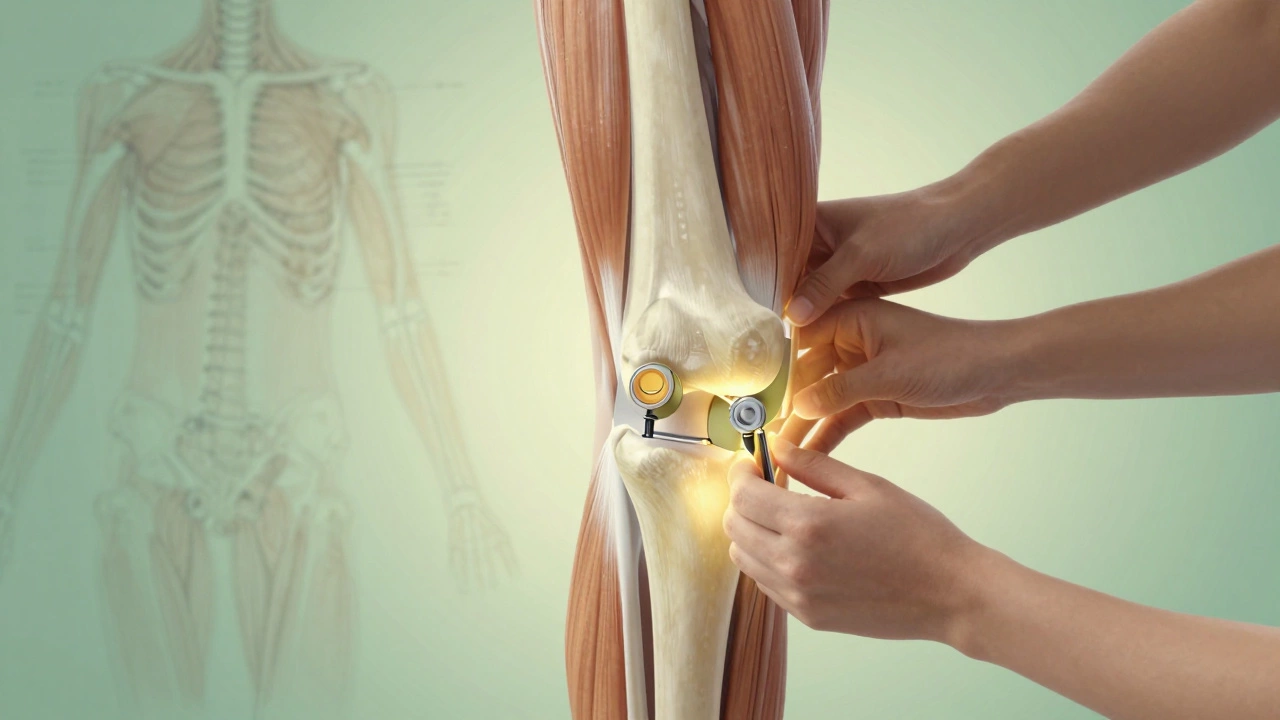
Total Knee Arthroplasty is surgical replacement of the knee joint with an artificial implant to relieve pain and restore function. Many surgeons consider knee replacement recovery harder than hip replacement because the knee is a hinge joint that bears full weight immediately, yet requires extreme flexibility to function normally.The primary enemy here is scar tissue formation. To get a normal gait, you need nearly 135 degrees of flexion. Getting there requires bending a swollen, bruised, and angry knee multiple times a day. Physical therapy sessions can be brutal. Patients often describe the sensation of bending their knee in the first few weeks as "grinding glass." The quadriceps muscle shuts down after surgery (arthrogenic muscle inhibition), meaning your leg literally forgets how to straighten. Re-activating this muscle is exhausting and painful.
Sleep is also severely impacted. Keeping the leg elevated to reduce swelling means sleeping propped up on pillows, which disrupts deep sleep cycles. Fatigue sets in quickly, creating a vicious cycle where tiredness reduces motivation for therapy, which leads to stiffer joints. However, once the range of motion is achieved, the quality of life improvement is dramatic, making the short-term suffering worthwhile for most.

Complex Joint Revisions and Revision Spine Surgery
If primary surgeries are hard, revision surgeries are significantly tougher. Revision Joint Replacement is a secondary surgery performed when a previous joint replacement fails, wears out, or becomes infected. These procedures take longer, involve more blood loss, and encounter dense scar tissue from the first operation.
In revision cases, the surgeon has to remove old cement and implants, which can weaken the surrounding bone. Sometimes, custom-made implants or bone grafts are needed. The post-operative swelling is greater, and the risk of complications like infection or nerve injury is higher. Recovery timelines are often doubled. A patient who recovered from a primary hip replacement in three months might take six to nine months for a revision. The emotional aspect is heavier too; patients have already failed once, leading to anxiety and hesitation during rehab.
Factors That Make Any Recovery Harder
Your personal health profile plays a massive role in how tough your recovery feels. Two people can have the exact same surgery, but one bounces back in weeks while the other struggles for months. Here are the key variables:
- Pre-habilitation: Patients who strengthen their muscles and optimize their nutrition before surgery recover faster. Weak muscles mean the bones and implants take all the stress.
- Age and Bone Density: Older adults with osteoporosis may have restricted weight-bearing protocols, prolonging bed rest and increasing muscle atrophy.
- Pain Tolerance and Mental Health: Anxiety and depression amplify pain signals. Patients with strong support systems and positive mindsets generally report easier recoveries.
- Smoking and Diabetes: Nicotine constricts blood vessels, slowing healing. High blood sugar impairs immune response and increases infection risk, potentially complicating recovery with additional treatments.
Comparison of Recovery Intensities
| Surgery Type | Average Hospital Stay | Key Challenge | Time to Independent Mobility | Full Recovery Time |
|---|---|---|---|---|
| Spinal Fusion | 2-4 Days | Strict BLT restrictions, muscle spasms | 2-4 Weeks | 6-12 Months |
| Total Hip Replacement | 1-2 Days | Dislocation precautions, bathroom safety | 1-3 Weeks | 3-6 Months |
| Total Knee Replacement | 1-3 Days | Painful range-of-motion exercises | 2-6 Weeks | 3-6 Months |
| Shoulder Replacement | 1 Day | Loss of upper body independence | 4-6 Weeks | 4-6 Months |
| Revision Joint Surgery | 3-5 Days | Increased swelling, weaker bone stock | 4-8 Weeks | 6-12 Months |
How to Prepare for the Hardest Recoveries
You can't change the surgery, but you can change how you handle the aftermath. Preparation is the single biggest factor in reducing perceived difficulty.
- Home Modification: Before surgery, install grab bars in the shower, raise the toilet seat, and clear tripping hazards. Move frequently used items to waist height so you don't have to bend or reach high.
- Build a Support Network: Identify who will drive you home, who will cook meals, and who will help with laundry. Do not assume family will know what to do; give them specific instructions.
- Pre-hab Exercises: Work with a physical therapist for 2-4 weeks before surgery. Strengthening the muscles around the surgical site reduces post-op strain.
- Nutritional Optimization: Increase protein intake to support tissue repair. Correct vitamin D and calcium deficiencies to aid bone healing. Stay hydrated to prevent constipation from pain meds.
- Mental Rehearsal: Visualize the recovery process. Accept that there will be bad days. Set small, achievable goals like "walk to the mailbox" rather than "run a marathon."
When to Worry: Red Flags During Recovery
Pain and swelling are normal, but certain symptoms indicate complications that need immediate attention. Knowing the difference prevents unnecessary panic and ensures timely care.
- Fever over 101°F (38.3°C): Could signal an infection at the surgical site.
- Excessive Redness or Drainage: Small amounts of clear fluid are normal; pus or increasing redness is not.
- Calf Pain or Swelling: Especially if one leg is larger than the other, this could be a Deep Vein Thrombosis (DVT), a blood clot that can travel to the lungs.
- Sudden Loss of Function: If you could walk yesterday but can't today, contact your surgeon immediately.
- Numbness or Tingling: Persistent nerve sensations may indicate nerve compression or damage.
Conclusion: Perspective Matters
While spinal fusion and complex revisions often top the list for "hardest" recoveries due to their length and restrictions, the truth is subjective. A shoulder replacement might be physically less demanding than a knee replacement, but losing the ability to dress yourself or lift a coffee cup can feel devastatingly hard emotionally.
The key is to respect the process. Orthopedic surgery is a trade-off: short-term suffering for long-term freedom. By preparing your home, your body, and your mind, you transform a daunting ordeal into a manageable chapter of your health journey. Listen to your body, stick to your physical therapy, and remember that progress is rarely linear. There will be setbacks, but with consistent effort, the majority of patients return to a pain-free, active life.
Is spinal fusion harder to recover from than hip replacement?
Generally, yes. Spinal fusion involves stricter long-term activity restrictions (no bending, lifting, or twisting) and a longer timeline for bone healing (6-12 months). Hip replacement has intense early precautions against dislocation, but most patients regain independent mobility faster than spinal fusion patients.
Which orthopedic surgery has the most pain during recovery?
Pain is subjective, but Total Knee Replacement is often cited as having the most intense acute pain due to the necessity of aggressive bending exercises. Spinal fusion tends to have more lingering, dull ache and muscle spasms rather than sharp pain.
How long does it take to fully recover from a total hip replacement?
Most patients can perform daily activities independently within 3 to 6 weeks. However, full recovery, including the resolution of all swelling and maximum strength gain, typically takes 3 to 6 months.
Can I speed up my orthopedic surgery recovery?
You can optimize your recovery by doing pre-hab exercises, maintaining a healthy weight, quitting smoking, and adhering strictly to physical therapy protocols. Consistency in rehab is the biggest factor in speeding up functional return.
What are the signs of a complication after orthopedic surgery?
Watch for fever, excessive redness or drainage from the incision, sudden increase in pain, calf swelling (sign of blood clot), or inability to bear weight if previously able. Contact your surgeon immediately if these occur.



Write a comment