
Metabolism Boost Protein Calculator
Calculate your ideal daily protein intake after 55 based on your weight and activity level. The article recommends 1.2-1.6g of protein per kg of body weight for optimal muscle maintenance and metabolism support.
After 55, many people notice something strange: no matter how little they eat or how much they walk, the weight won’t budge. Even small snacks seem to stick around. It’s not laziness. It’s not bad willpower. It’s your metabolism slowing down - and it’s completely normal. But it’s not unstoppable.
Why Your Metabolism Slows After 55
Your body doesn’t slow down because you’re getting older. It slows because you’re losing muscle. Starting around age 30, you lose about 3-5% of your muscle mass every decade. After 55, that loss accelerates, especially if you’re not lifting weights or moving regularly. Muscle burns calories even when you’re sitting still. Fat doesn’t. So as muscle drops and fat increases, your resting metabolic rate - the number of calories your body burns just to keep you alive - can drop by 10-20% over 10 years.
On top of that, hormone changes play a role. Testosterone in men and estrogen in women decline, which affects how your body stores fat and uses energy. Thyroid function can dip too, though it’s not always the main culprit. And let’s not forget sleep. Poor sleep after 55 is common, and every hour of lost sleep can lower your metabolic rate by up to 5% the next day.
Strength Training Is Non-Negotiable
The single most effective way to boost your metabolism after 55 is to build or keep muscle. Not cardio. Not juice cleanses. Strength training.
Studies from the American College of Sports Medicine show that older adults who lift weights two to three times a week can increase their resting metabolism by 7-10% in just 12 weeks. That’s the same as burning an extra 100-150 calories a day without doing anything else.
You don’t need a gym. Start with bodyweight exercises: chair squats, wall push-ups, step-ups onto a low stair, and seated rows with resistance bands. Do three sets of 10-12 reps, two days a week. After four weeks, add light dumbbells - even 2-5 pounds makes a difference. Focus on big movements that work multiple muscle groups: legs, back, chest, and core. These burn the most calories during and after the workout.
One 62-year-old woman in Sydney started doing seated leg lifts and wall squats at home. After six months, she lost 14 pounds without changing her diet. Her doctor said her muscle mass had increased by 8%. That’s the power of lifting.
Protein Isn’t Just for Bodybuilders
After 55, your body becomes less efficient at using protein to build muscle. This is called anabolic resistance. You need more protein than you did at 30 to get the same muscle-building effect.
Research from the University of Texas suggests older adults need at least 1.2 grams of protein per kilogram of body weight daily - and up to 1.6g/kg if you’re active. That’s about 80-100 grams of protein a day for most people.
Spread it out. Don’t eat 20 grams at breakfast and 5 grams at lunch. Aim for 25-30 grams of protein per meal. Good sources: eggs, Greek yogurt, lean chicken, tofu, lentils, cottage cheese, and whey protein powder mixed into smoothies. One large egg has 6 grams. A cup of Greek yogurt has 18. A 100g chicken breast has 31.
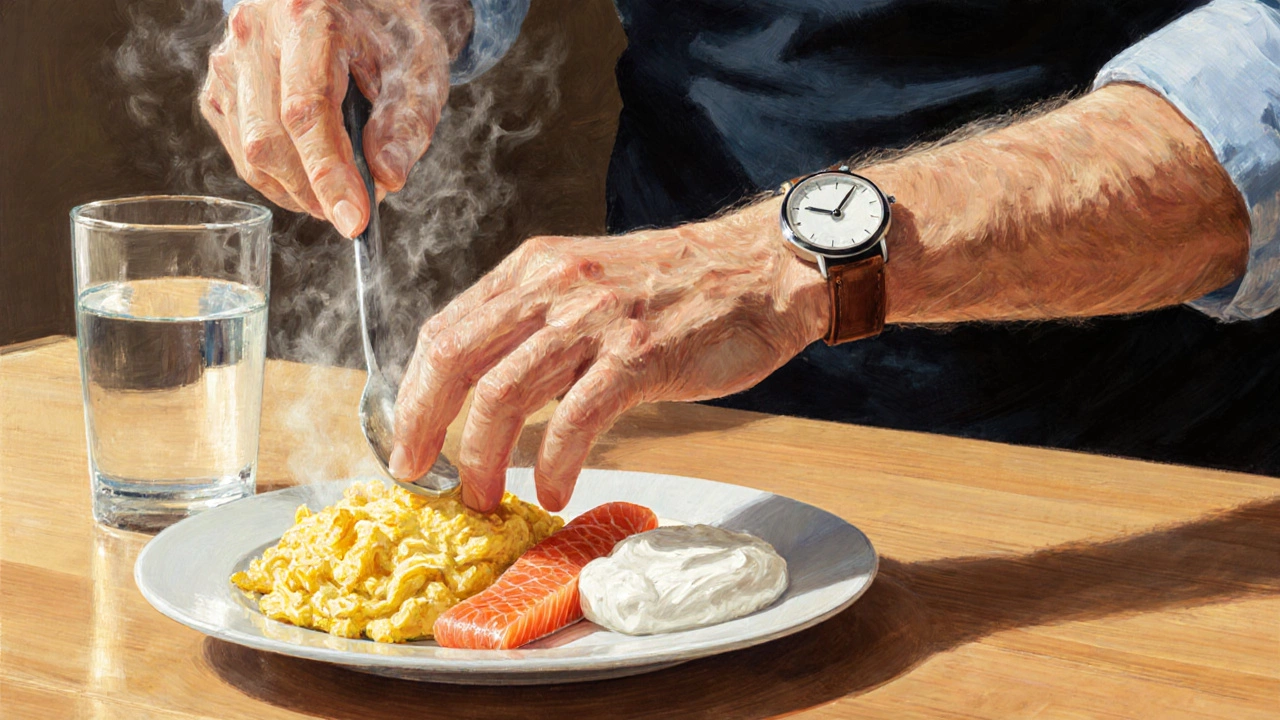
One man in his late 50s ate the same calories every day but switched from toast and jam for breakfast to scrambled eggs and smoked salmon. Within three months, his energy improved, his waist shrank by two inches, and his fasting blood sugar dropped. He didn’t cut carbs - he just ate more protein.
Movement Matters More Than You Think
Walking 10,000 steps a day sounds great - and it is. But if you sit for 14 hours a day, even 10,000 steps won’t fully offset the damage. Sitting too long turns off enzymes that burn fat. Your body literally stops using glucose and fat for energy.
Set a timer. Every 45 minutes, stand up for 2-3 minutes. Walk to the kitchen. Stretch. Do calf raises while brushing your teeth. Park farther away. Take the stairs. These tiny movements keep your metabolism active. A study in the Journal of Physical Activity and Health found that older adults who broke up sitting with short walks every hour burned 10-20% more calories than those who sat for long stretches.
Combine this with daily walking. Aim for 30 minutes at a pace where you can talk but not sing. That’s moderate intensity. It keeps your heart healthy and your fat-burning systems working.
Sleep and Stress Are Hidden Metabolism Killers
If you’re not sleeping well, your metabolism is suffering. Poor sleep raises cortisol, the stress hormone that tells your body to store belly fat. It also lowers leptin (the fullness hormone) and raises ghrelin (the hunger hormone). You feel hungrier, especially for carbs and sugar.
Try this: Get at least 7 hours of sleep. Turn off screens 90 minutes before bed. Keep your room cool - around 18-19°C. Avoid caffeine after 2 p.m. If you wake up at night, don’t check your phone. Just breathe slowly for five minutes.
Stress does the same thing. Chronic stress - from family worries, money, or loneliness - keeps cortisol high. That means fat sticks around, especially around your middle. Try daily breathing exercises, short walks in the park, or even listening to calming music. Ten minutes a day makes a measurable difference.
What Doesn’t Work - And Why
Detox teas? Fasting for 16 hours? Cutting carbs completely? These might give you a quick drop on the scale, but they don’t fix your metabolism. In fact, they can make things worse.
Extreme dieting after 55 causes muscle loss. Your body breaks down muscle for energy when you don’t eat enough. That lowers your metabolism even more. Fasting can be helpful for some, but if you’re not eating enough protein or lifting weights, you’ll lose muscle faster than fat.
Supplements like green tea extract, caffeine pills, or “metabolism boosters” have tiny, short-term effects at best. One study in the American Journal of Clinical Nutrition found that green tea extract increased calorie burn by only 4% over 24 hours - about 80 extra calories. That’s less than one banana. And many supplements aren’t regulated. They can interact with medications or cause heart issues.
Don’t waste money on quick fixes. Focus on what moves the needle: muscle, protein, movement, sleep.
Realistic Expectations: It’s About Energy, Not Just Weight
Speeding up your metabolism after 55 isn’t about becoming a 25-year-old again. It’s about feeling strong, having energy, and keeping your independence. Losing 1-2 pounds a month is a win. Gaining muscle, even a pound or two, is a bigger win.
One woman in her 60s started strength training and eating more protein. She didn’t lose much weight, but she stopped needing a cane to walk. She could carry groceries, play with her grandkids, and sleep through the night. That’s the real goal.
Your metabolism doesn’t have to be your enemy. It just needs the right signals: movement, food, rest. Give it those, and your body will respond - even at 65, 70, or beyond.
Can I speed up my metabolism after 55 without exercise?
No, not effectively. While eating more protein and improving sleep helps, muscle loss is the main driver of metabolic slowdown after 55. Without strength training, you’ll continue losing muscle, and your metabolism will keep dropping. Exercise isn’t optional - it’s the foundation.
How much protein should I eat daily after 55?
Aim for 1.2 to 1.6 grams of protein per kilogram of body weight. For a 70kg person, that’s 84-112 grams per day. Spread it across three meals: 25-35 grams at breakfast, lunch, and dinner. Good sources include eggs, Greek yogurt, chicken, tofu, lentils, and whey protein.
Does drinking cold water boost metabolism?
Drinking cold water burns a few extra calories - about 8-10 calories per glass - because your body warms it up. But it’s not a meaningful way to boost metabolism. Focus on protein, movement, and sleep instead. Hydration matters, but don’t rely on cold water as a metabolic fix.
Are metabolism-boosting supplements safe after 55?
Most are not worth it. Supplements like green tea extract, capsaicin, or caffeine may slightly increase calorie burn, but the effect is tiny and temporary. Many contain unregulated ingredients that can raise blood pressure or interfere with medications. Always talk to your doctor before taking any supplement, especially if you have heart issues or take blood pressure or thyroid meds.
Why am I gaining weight even though I eat less?
You’re likely losing muscle and gaining fat. As you age, your body becomes less efficient at using protein and more likely to store fat, especially if you’re inactive. Eating less without strength training means your body breaks down muscle for energy. This lowers your metabolism, so fewer calories are burned - even if you’re eating less. The solution: eat more protein and move more.
Next Steps: Start Small, Stay Consistent
Don’t try to change everything at once. Pick one thing to start this week:
- Do two 20-minute strength sessions using resistance bands or bodyweight (e.g., squats, wall push-ups, seated rows).
- Add one extra serving of protein at breakfast - swap toast for eggs or Greek yogurt.
- Set a phone reminder to stand up every 45 minutes.
Do those for 30 days. Then add one more. You don’t need a gym. You don’t need a diet plan. You just need to move, eat protein, and rest. That’s how you rebuild your metabolism - one day at a time.




Write a comment